Showing posts with label things that are totally sweet and awesome. Show all posts

Saturday, January 26, 2013

Who are we? Don't ask our neurons, they're a bunch of idiots. And don't answer with your gut, because your gut isn't even human.

As the philosopher Daniel Dennett likes to remind us, each one of us is made up of trillions and trillions of living organisms (we call them 'cells'), and not a single one of these living things that make us up has any idea who we are, or even cares.

Take a moment to let that sink in.

Now, don't blame the cells for not caring; they are all living organisms and thus have their own metabolism, their own respiration, and their own reproduction to manage.  They don't have the time to worry about the bigger picture.  Nor do they have the mental capacity.  Even neurons--the living organisms that do our thinking for us--are quite dumb, when considered on an individual level.  Even though it is our neurons that allow us to think and learn, no individual neuron can think or learn.  Each one follows very simple rules of behavior: basically if a certain number of its neighbors are firing, they fire too.  That's it.  And yet somehow, out of all those mindless firings of neurons, a mind emerges--a mind that can even write a blog post about the neurons mindlessly making a mind.

Three stupid neurons.

More than human.
It gets even weirder.  A good proportion of the cells that make us up aren't even human!  Before I tell you what percentage, I invite you to take a guess: What percentage of the cells in our body are human cells?  90%? 70%? 50%?  So far, you're way off.  (Are your neurons even firing correctly?  Sheesh.)  Truth is, human cells are the in the minority amongst humans, by a long shot.

Human cells comprise only about 10% of the 100 trillion cells in a human.  10%.  The rest of the cells in our body are mostly bacteria, which generally take up residence in our gut.  Far from being invasive, our bacterial friends are an integral part of our digestive system, breaking down food and passing along the energy and vitamins to us after they're done with them.

Are you the same "you" that you were 10 years ago?
Biologically speaking, not exactly.  The living organisms that make us up generally do not live long enough to see us grow old.  Our body may grown and develop at a steady, slow pace, but that is due to a complex flux of cells dying and new cells being born to take their place (here's a nice NYT article on this).  The skin that covers your entire body--the thing that makes you look like "you" with your dimples and wrinkles and all--is not even the same skin you had two weeks ago.  The stable patterns in our skin, including our fingerprints and dimples and wrinkles and all, are sort of like traffic jams that persist even after all individual the cars that started the jam travel on down the road.

Down another level, they say that most of the atoms and molecules that make up the cells are replaced by other atoms (of the same variety) every year or so.  Since the new atoms are functionally equivalent to the old atoms, we would never know the difference.

So what are we to make of this?
So, if the neurons that make us think are all stupid, and the cells that make us up are dying all the time, how do we think?  How do we persist?

Part of what makes this all so mysterious is that we are so far removed from the microscopic level of the goings-on of our body that we have no sense of how the micro-level goings-on give rise to the macro-patterns of our daily life.  But there are some systems in nature where the levels are not so far removed, and so we can learn something about this mystery by studying them.  I will briefly introduce you to two of them: slime molds, and ant colonies.

Slime molds
The slime mold may be one of the grossest organisms on earth, but it is also one of the most fascinating.  We humans like to think of our life cycle in terms of our whole body, not our cells, but the life cycle of the slime mold doesn't work like that.

The slime mold spends much of its life as a single-celled organism, not unlike an amoeba, generally sliming around.  But there comes a point in the life cycle where tens of thousands of individual cells come together and act like one big organism.  First this aggregate organism looks like a slug, slithering around, eating, sliming, and doing whatever it is slugs like to do.  Then during it's reproductive stage the slime mold self-organizes into a mushroom-like stalk, releasing new spores into the surrounding environment and starting the whole process over again.


Although individual slime mold cells are just about as dumb as our individual neurons, the aggregate of slime mold cells can be pretty darned smart.  For example, they can find their way through a complicated maze to get to food:

Ant colonies
Although ants may be smarter than slime mold cells, they are still pretty dumb.  What I mean by that is that ants follow a very simple algorithm for guiding their behavior, a very simple decision-making procedure based entirely on pheromones.

If, in their walking around, an ant happens to cross paths with another ant, they give each other an antennae high-five and sniff out the pheromones.  There is a pheromone that signal one of a few basic meanings: "I found food" and one for "I'm working on the hive" and another for "there's a threat to the colony".  If they sniff the pheromone for "I found food", then they head in the direction that ant was coming from, repeating the process with other ants, until it ultimately finds the food.  This is not much different than our dumb neurons' algorithm of "if my neighbors are firing, I will too".

Now, despite being made up of dumb ants, an ant colony is pretty darned smart.  For instance, they can solve the complicated problem of allocating the optimal number of ants to various food sources at various distances with varying amounts of food.  (here's a nice TED talk on the emergent intelligence of ant colonies)


Also, ant colonies persist for decades, even though the individual ants generally die after several months or at most a few years.  (The queen is the exception to this rule, she's around for up to 21 years).


So, ant colonies and slime molds each give us insight on how a form of intelligence can emerge from the collective behavior of dumb individuals, much like mindless neurons can collectively make a mind. They also lend insight onto the persistence problem, how we can be around for decades when most of our cells are long dead by then.

The bigger picture.
Now that we've seen there's no real magic to how we can be composed out of a bunch of dumb organisms but still be relatively smart, there are more questions to consider.  Should we feel bad if we scratch our cheek and kill thousands if not millions of living organisms?  Is it possible that individual humans could be part of some larger system that is even smarter than any individual humans?  If so, should that system feel bad if it happens to "scratch it's cheek" and wipe out thousands if not millions of humans?  And what should we call that system?  I propose that we call this hypothetical system "Frank."  Frank, if you're listening, please don't scratch your cheek!!!


Extra goodies:

  • this article also reports on a finding that human cells even forage for food in a pattern similar to other scavengers, including sharks and um, penguins
  • another video of slime mold finding the shortest path to food through a maze 
  • here's a research article on the how ant colonies solve complicated problems with dumb ants

Saturday, August 20, 2011

Electrons have their cake and eat it too...

A zen monk named Yogi Berra once said, "If you see a fork in the road, take it."  Quantum mechanics has shown us that elementary particles, such as electrons and photons, seem to take Yogi's advice.  That is, when an experimental physicist gives a quantum particle such as an electron or a photon a choice between two paths, it can take both at once.  This is evidenced by an interference pattern that results when you recombine the paths at the other end of the experimental apparatus.  The interference pattern shows that not only does the particle take both paths, but it actually "gets in its own way" as it does so! 

But it gets weirder.  The electron does not always take both paths.  Sometimes it takes one path or the other.  But this only happens when you try to find out which path it took!  In fact, the more you know about the path of the electron, the less likely it is to show an interference pattern.  In other words, the electron seems to respond how much we *know* about it!  If we set up our experiment to get any "which path" information, it will only take one path.  But if we set up our experiment so that we do not know which path it took, it will give an interference pattern showing that it took both paths.  So we can decide, based on how we set up our experiment, whether an electron took one path or both paths. 

But it gets EVEN weirder!  Not only can the experimental physicist decide whether it took one path or both paths by changing how they set up the experiment, but they can do so *retroactively*, i.e., after the electron has made its way through the path(s)!!  This is called the delayed-choice experiment.  Here is a description from John Wheeler, who came up with the idea:


In the 1970's, I got interested in another way to reveal the strangeness of the quantum world. I called it "delayed choice." You send a quantum of light (a photon) into an apparatus that offers the photon two paths. If you measure the photon that leaves the apparatus in one way, you can tell which path it took.
If you measure the departing photon in a different way (a complementary way), you can tell if it took both paths at once. You can't make both kinds of measurements on the same photon, but you can decide, after the photon has entered the apparatus, which kind of measurement you want to make.
Is the photon already wending its way through the apparatus along the first path? Too bad. You decide to look to see if it took both paths at once, and you find that it did. Or is it progressing along both paths at once? Too bad. You decide to find out if it took just one path, and it did.


The delayed-choice experiment may be weird, but it is not mere science fiction.  It was first carried out by physicists at the University of Maryland, where I go to school.  Actually one of the physicists who did the experiment works across the hall from the office where I spent most of my time here, Dr. Alley. 

Shih & Alley carried out the delayed-choice experiment in the late 1980's using photons, and it has been replicated several times since then.  They decided, retroactively, whether the photon took one path or both paths by shifting the experimental arrangement after the photon was well on its way along the path(s), several nanoseconds after it would have had to "choose" one path or the other.

But wait, it gets EVEN WEIRDER!!  In principle, as Wheeler has pointed out, this experiment could be carried out using astronomical sources.  A photon from a distant quasar, for instance, could have the option of taking two paths towards Earth due to an effect called gravitational lensing.  The photon could go straight to Earth or it could be pulled around another path by the strong gravitational force by a galaxy along the way.  Since we can still decide whether the photon took one or both paths by how we set up the experimental apparatus on Earth to measure "which path" information or to find an interference pattern, we can decide which path(s) the photon took BILLIONS OF YEARS AFTER it had to have taken them!

Good luck getting to sleep tonight.


Tuesday, April 14, 2009

Will humans have the last laugh?

We humans, when looking around at all the creatures who we share the Earth with, have since time immemorial have considered ourselves to be special. The chosen ones. The cool kids. And we've had plenty of good reasons to think so. We use tools, we make fire, we socialize, we have good memory, we have concepts & reason, and, of course, we have breakdancing. Aristotle went so far as to define Man as "the rational animal". It's no wonder, given all of our special abilities, that we have concluded that we are divine, in some sense. We look at the world around us, and we "get it" in a way that a dog or a giraffe does not. We must have something extra that accounts for this awareness—a soul. A divine Creator who considers us to be his finest creation.

The more we have studied science, the more it has challenged our special status on Earth and within the cosmos. Copernicus had to convince everyone that the universe does not revolve around us, literally. We are just one of a handful of big rocks revolving around the Sun. The Sun, it was found out, is nothing but your average middle-aged star. In the last quarter decade, we have found hundreds of planets scattered throughout the galaxy. The more we looking out into space, the more it seems were no more special than a grain of sand on a vast beach. But at least we humans are the king of our little grain of sand, right?

Well…even on Earth we're finding out that humans aren't so special. We've always tried to set ourselves apart from the species we share the planet with, but nearly every unique characteristic of humanity apparently has its example in the animal kingdom as well.

Using the wonders of the world wide internet, something the animals haven't caught onto yet, I have accrued a some amazing videos featuring animals doing things previously thought unique to humans. Enjoy, and thank god for opposable thumbs!!

Tool Use:

http://www.youtube.com/watch?v=TtmLVP0HvDg This crow decides to bend a wire into a hook to get some food

http://www.youtube.com/watch?v=4RpOGYYKdaQ This crow figures out it can use a stick to get some food across the cage

http://www.youtube.com/watch?v=wfRqYjv9QgA Finally, an octopus that can open my beers for me!


Problem Solving:

http://www.youtube.com/watch?v=ySMh1mBi3cI This chimp is smarter than me, I'll tell you that.

Problem Solving by Cooperation & imitation:

http://www.youtube.com/watch?v=xOrgOW9LnT4 These chimps solicit help to complete tasks they can't do themselves. They also step in to help others, too! Nice chimps.

http://www.youtube.com/watch?v=yhG-_KsDYTA These chimps keep up with the Jones'—they learn to use a complicated device by watching their neighbors.

http://www.youtube.com/watch?v=0GOb3nFpewM These dolphins help out the local fishermen

Self-awareness:

http://www.youtube.com/watch?v=W-pc_M2qI74 Chimps can recognize themselves in a mirror…humans can't do this in general until they're 2 or 3.


Language:

http://www.youtube.com/watch?v=jz3sQsTE5tA These dolphins understand 60 words and thousands of sentences, including word order.

http://www.youtube.com/watch?v=SN5igku_kGk Wild honeyguide birds, who speak specifically to humans! This is my personal fav...


Play & Laughter:

http://www.youtube.com/watch?v=myuceywaOUs Rats laugh when they get tickled! I guess we just never knew because we were never really tempted to tickle a rat…

http://www.youtube.com/watch?v=TMCf7SNUb-Q Dolphins blowing bubble rings & playing with them…very cool!


Culture & Medicine

http://www.youtube.com/watch?v=5ghocsuXVVU These chimps have tribe-specific cultural knowledge, including smooching, shaking hands, and herbal medicine!


Symbolic language: These apes not only draw to communicate, they also start fires, play Pac-man…lookout!!

http://www.youtube.com/watch?v=a8nDJaH-fVE


Tuesday, July 29, 2008

Guess who's back in style??

Back in style:
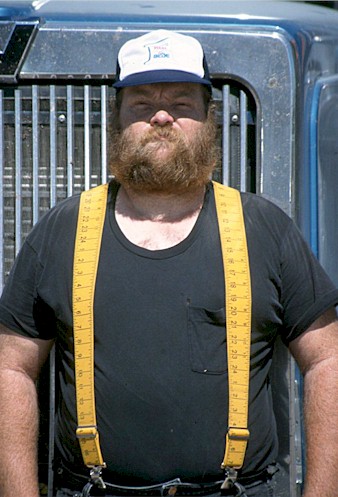
Truckers! Truckers stole our hearts with their dedication to supply all of our goods while looking stylish and talking cool the whole time.
Ten-four there, Goldie Wang. This is Rubber Duckie. What's your ten-twenty? Over.
Back in Style:
Ninjas! Ninjas are sweet and totally fast. They will kick you in the face and not think twice about it. That's why ninjas are cool again.
3 Facts about ninjas:
1. Ninjas are mammals.
2. Ninjas fight ALL the time.
3. The purpose of the ninja is to flip out and kill people.


Back in Style:
Pirates! Avast! If'n ye don't think pirates be grand, fine booty, then by the powers you land-lubbers will be fixin' for a taste of the cat o' nine tails. Argghh.
Q: What kind of socks to pirates wear?
A: AAAARRRRGGGGuile


Soon to be back in style:
Pilgrims! Pilgrams are zany and happy-go-lucky, as you can tell by their hats. They love to eat corn, make cornucopias and fire muskets. Fact: A pilgrim can make 3x his/her own bodyweight worth of pumpkin pie in one sitting. That's why pilgrims are going to be the next big thing.
In honor how cool pilgrims are, I hereby declare this Friday, August 1st 2008 to be the first annual International Dress-Like-a-Pilgrim Day!!! Who's with me??