Showing posts with label science. Show all posts

Tuesday, August 3, 2021

When vaccination rates are high, most positive cases will be among the vaccinated (and that's okay)

Two recent COVID outbreaks have made headlines because of the high proportion of "breakthrough" cases, where people test positive for COVID despite being fully vaccinated.  San Francisco hospitals in July reported 50 staff members tested positive for COVID, despite 75% of them being vaccinated.  In Provincetown, MA, a July outbreak of the delta variant led to several hundred new cases, the majority of whom were fully vaccinated.
How can the majority of new cases be among the vaccinated?  Some people wrongly (if understandably) worry this means the vaccines aren't working, particularly against the delta variant. 

The truth is the numbers show that the vaccines ARE very effective, even against the delta variant.

The problem here is the reporting.  News agencies are going for provocative headlines, and in the process are falling for what is known in statistics as the "low base rate fallacy" or base rate bias.  In this case, breakthrough infections have a very low base rate, and all of other numbers are meaningless without keeping that in mind.  

The low base rate of breakthrough infections should be the focus in reporting.  For instance, the headline does not mention that the 50 new cases in July among SF hospital staff is out of 7,500 staff members, a breakthrough base rate of less than 1%.  They don't mention that until later in the article.

How can positive rates be higher among the vaccinated?

What does it mean that, in the delta outbreak in Provincetown, there were a higher proportion of positive cases among vaccinated folks compared to unvaccinated?  Does it mean the vaccine is ineffective agains the delta?  NO.  Because of the low base rate, when vaccination rates are high, more positive cases will be among the vaccinated.  

What it really means is just that most people in MA are vaccinated! To understand this, a picture is worth 1000 words. I came across this diagram that clearly shows what's going on. 


source: https://i.redd.it/cpjwvqv2s0d71.png

The left half of the diagram shows what happens in a highly vaccinated population, based on real-world data from England.  There was a 2% chance of getting symptomatic COVID among the unvaccinated (red dots).  For the vaccinated, it was a much smaller percentage who got COVID (only 20% of 2%, aka 0.4%).  But since so many more people were vaccinated (over 10x as many), that led to a higher number of vaccinated people who tested positive (blue dots).  This explains the counterintuitive result that even though the vaccine is working, more people who test positive are vaccinated.  There's just so many more vaccinated people! (Notice there are still way fewer vaccinated who end up hospitalized.)

The right half of the diagram shows what happens when a lower percentage of the population is vaccinated.  First - and most importantly - there are more overall cases and hospitalizations.  Second, since there are more unvaccinated people, the higher proportion of people who test positive are unvaccinated.  This matches our usual intuitions.

In summary: When most people are vaccinated, it brings down the total # of positive cases drastically (yay!), but can end up with a higher proportion of positive cases among vaccinated folks. This can be confusing, because humans aren't great at doing statistics when there's a low base rate involved.  It really helps to visualize it. 

Remember that breakthrough cases are normal and to be expected, and extremely rare in reality (much less than 1% in MA and nationwide). The vaccines help in multiple ways: they reduce positive cases and also lead to a lower rate of hospitalization among those who test positive (only 1% of vaccinated positives from the recent MA delta outbreak were hospitalized). 

TLDR: Vaccines are working well, even when a higher percentage of positive cases are among the vaccinated!

Epilogue: Simpson's Paradox
The base rate fallacy leads to all sorts of funky, counterintuitive results:  
  
  • My favorite comes from baseball - In 1989 Andy Van Slyke had a higher batting average than David Justice (0.237 vs. 0.235).  In 1990 Van Slyke again had a higher average than David Justice (0.284 vs. 0.282).  But when you look at their combined 2-year battering average 1989-1990, David Justice is the one with the higher average (0.278, compared with Van Slyke's 0.261).  How can this be?  David Justice had far fewer at bats in 1989, so his combined average is skewed closer to his 1990 season.  
  • Simpson's paradox is what philosophers and statisticians call an association between variables at the population level that reverses when divided into subpopulations.  Understanding Simpson's paradox has important ramifications for epidemiology and for equity.
  • At the population level, vaccinated people are less likely to get COVID.  But when comparing vaccinated to unvaccinated, a higher proportion of new cases can be among the vaccinated.  This is Simpson's paradox.  Of course, it's not truly a paradox - it is just so counterintuitive you have to think it through carefully. Every. Time.

Wednesday, December 30, 2009

What’s really happening

A story about stories

There is a fundamental paradox that we are all vaguely aware of, even if we haven’t quite articulated it to ourselves.  Unlike the paradoxes of physics and philosophy, which we may never personally encounter, this paradox resides right under our noses.  More specifically, it resides right at the tip of our tongue.  It also buzzes incessantly right between our ears, being the fabric out of which even our internal monologue is woven.    It is the paradox of storytelling—the holy trinity of the story, its teller, and its audience. 


When I say storytelling you probably think of the sorts of storytelling done by professionals such as Twain or Poe, or the kind that is performed to a group sitting around a campfire or a dinner table.  And I do mean those; but I don’t mean only those.  I mean storytelling as grand as telling the story of our cosmic origins, or as minute as silently but persistently telling ourselves what it is we are thinking about at the moment…and everything in between.

We are all storytellers.

Historians compose stories about civilization, the ideologies and innovations that compete and collaborate to form periods of stability, progress, and revolution.

The press and its journalists compose stories that amount to the history of “now”—events at the intersection of people, their roles, and the motivations that drive them to act according to their roles.

Biologists tell same sorts of stories as historians and journalists; the differences amount to ones of scope, with roles played by very different sorts of characters, the innovations of a much less teleological nature, and the motivations largely being those of survival.  But really these are not such dramatic differences after all.

Physicists tell causal stories about particles and their interactions.

Your mind tells stories about you, what you’re doing, what you have done, and what you plan to do.

How many stories are there?

We like to think of history as a continuous stream of goings-on.  So much so that we each tend to decide on one story and stick with it, quickly forgetting, ignoring or even deleting versions that don’t jive with it.  We all know it’s the winners that write the history books; this is true of the shared history written down in books as well as our personal histories written down in our stream of consciousness.  But if you’re really observant, you can sometimes spot multiple drafts of the same story before one get chosen and the other swept under the carpet. 

Case in point: the recent protests in Iran (video).  There are two major versions of the same events.  I’d like you to suspend judgment, if just for a moment, which version you believe.  (btw I’m going off this NY Times article)

Version #1: The Iranian government says that western countries helped orchestrated the protests, and that shots from the crowd struck and killed several people, including Ali Mousavi, the nephew of the opposition leader.

Version #2: The people in the street says that the protests were peaceful, but that revolutionary guard soldiers violated the rules of the holy day by shooting into the crowd, possibly even assassinating the nephew of the opposition leader.

These two versions of the story seem completely incompatible.  How can one person ever believe both at the same time?  How can it be decided which version is a “factual” account of the events?  Most likely what will happen is that one group of people will believe one version, and another will believe the other.  Whichever story gets believed by more people in the end will survive and become the “official” account, the other will pretty much die away.

What’s the real story, and who gets to tell it?

And now for the paradox. 

We all know that there are many sides to a story.  And so it makes sense to say that there is no one real story of what really happened.  There are only versions of stories, which are unavoidably colored by who is telling them and who they are being told to. 

But on the other hand, to say that there is no privileged version of what really happened—there is no plain and simple truth, no bare fact of the matter—seems totally crazy. 

I think this paradox, just like any paradox worth its mettle, is inherently unresolvable.  But that does not make it a dead end.  Keeping this paradox in mind helps us remember that we may always be wrong about even the things we’re most certain of.  I think this is a crucial step—perhaps THE crucial step—towards the peaceful resolution of conflict.

Tuesday, April 14, 2009

Will humans have the last laugh?

We humans, when looking around at all the creatures who we share the Earth with, have since time immemorial have considered ourselves to be special. The chosen ones. The cool kids. And we've had plenty of good reasons to think so. We use tools, we make fire, we socialize, we have good memory, we have concepts & reason, and, of course, we have breakdancing. Aristotle went so far as to define Man as "the rational animal". It's no wonder, given all of our special abilities, that we have concluded that we are divine, in some sense. We look at the world around us, and we "get it" in a way that a dog or a giraffe does not. We must have something extra that accounts for this awareness—a soul. A divine Creator who considers us to be his finest creation.

The more we have studied science, the more it has challenged our special status on Earth and within the cosmos. Copernicus had to convince everyone that the universe does not revolve around us, literally. We are just one of a handful of big rocks revolving around the Sun. The Sun, it was found out, is nothing but your average middle-aged star. In the last quarter decade, we have found hundreds of planets scattered throughout the galaxy. The more we looking out into space, the more it seems were no more special than a grain of sand on a vast beach. But at least we humans are the king of our little grain of sand, right?

Well…even on Earth we're finding out that humans aren't so special. We've always tried to set ourselves apart from the species we share the planet with, but nearly every unique characteristic of humanity apparently has its example in the animal kingdom as well.

Using the wonders of the world wide internet, something the animals haven't caught onto yet, I have accrued a some amazing videos featuring animals doing things previously thought unique to humans. Enjoy, and thank god for opposable thumbs!!

Tool Use:

http://www.youtube.com/watch?v=TtmLVP0HvDg This crow decides to bend a wire into a hook to get some food

http://www.youtube.com/watch?v=4RpOGYYKdaQ This crow figures out it can use a stick to get some food across the cage

http://www.youtube.com/watch?v=wfRqYjv9QgA Finally, an octopus that can open my beers for me!


Problem Solving:

http://www.youtube.com/watch?v=ySMh1mBi3cI This chimp is smarter than me, I'll tell you that.

Problem Solving by Cooperation & imitation:

http://www.youtube.com/watch?v=xOrgOW9LnT4 These chimps solicit help to complete tasks they can't do themselves. They also step in to help others, too! Nice chimps.

http://www.youtube.com/watch?v=yhG-_KsDYTA These chimps keep up with the Jones'—they learn to use a complicated device by watching their neighbors.

http://www.youtube.com/watch?v=0GOb3nFpewM These dolphins help out the local fishermen

Self-awareness:

http://www.youtube.com/watch?v=W-pc_M2qI74 Chimps can recognize themselves in a mirror…humans can't do this in general until they're 2 or 3.


Language:

http://www.youtube.com/watch?v=jz3sQsTE5tA These dolphins understand 60 words and thousands of sentences, including word order.

http://www.youtube.com/watch?v=SN5igku_kGk Wild honeyguide birds, who speak specifically to humans! This is my personal fav...


Play & Laughter:

http://www.youtube.com/watch?v=myuceywaOUs Rats laugh when they get tickled! I guess we just never knew because we were never really tempted to tickle a rat…

http://www.youtube.com/watch?v=TMCf7SNUb-Q Dolphins blowing bubble rings & playing with them…very cool!


Culture & Medicine

http://www.youtube.com/watch?v=5ghocsuXVVU These chimps have tribe-specific cultural knowledge, including smooching, shaking hands, and herbal medicine!


Symbolic language: These apes not only draw to communicate, they also start fires, play Pac-man…lookout!!

http://www.youtube.com/watch?v=a8nDJaH-fVE


Tuesday, April 1, 2008

Shame on you, Ben Stein (part 1)

I just gave in and clicked on one of the advertisements that gmail subtly displays while I check my inbox. What I saw when I clicked it was so disturbing that, against my better judgment, I will discuss it here since chances are you will probably hear about it anyway from other sources.

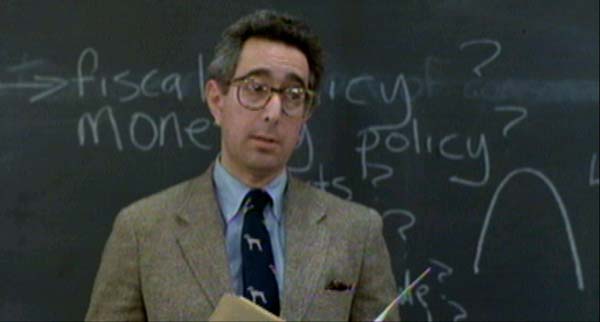
Ben Stein, THE Ben Stein, i.e., Ben "Beuler? Beuler? Anyone? Anyone?" Stein, former speech writer for two U.S. Presidents and former Emmy-winning game show host of an entertaining know-it-all game show, has made an anti-Darwinism "documentary" style movie that is set to hit theatres soon. What the?


For many months, I didn't click on the link that taunted me by saying, "Expelled – Ben Stein - www.Expelledthemovie.com - Why is Big Science suppressing the evidence of Intelligent Design?" It was the "Ben Stein" part that first caught my eye. "Why is Big Science suppressing the evidence of Intelligent Design" part did not catch my eye, because in my time on the internet I'm used to seeing such ridiculous statements all the time. But then what really caught my eye and made me click on the link was the fact that Ben Stein and this ridiculous statement were for one and the same link. Surely, they mean some crackpot religious zealot that happens to be named Ben Stein—they don't mean THE Ben Stein—the intellectual and hip pop-culture icon Ben Stein, right? Wrong.


Creationists used to make me really uncomfortable. I used to get in heated debates with them until we were both literally red in the face. This is no longer the case. I have gained some understanding of a few things. The first that I realized is that I cannot, by arguing with them at a Starbucks, convince a creationist to a doctrine that they perceive to be completely at odds with what they believe. The second, and more important, thing that I realized is that it makes sense to me that certain people are creationists. If you believe that God created this world, AND you believe that the Bible is the immutable word of God, AND you take all the words of the Bible at face value, THEN it seems you must believe that the world was created about 10,000 years ago. And if the purpose of life is to fulfill God's will, than what could be more important? It now makes sense to me why certain people believe their religious beliefs over their scientific beliefs, even if I don't see it that way.

Am I a little surprised that Ben Stein, presumably a gifted and intelligent academic, is a creationist? Yes, a bit. But in my eyes, that does not make him a zealot or an idiot. You can be plenty rational, plenty intelligent and be a creationist.


What I am appalled at is the message Ben Stein is about to send to millions of viewers, that Darwinists are getting defensive because they are 'hiding something.' What I am even MORE appalled at is the fallacious propaganda he is using to send this message. And I do not use the word propaganda in any hyperbolic sense of the word; I mean it quite literally and seriously. It is disgusting.


Let's take a look just at the advertisement itself, shall we? "Why is Big Science suppressing the evidence of Intelligent Design?" This alone already contains at least seven clearly identifiable propaganda techniques. Let's spell them out, shall we? The first is a fallacy known in the practice of law as the "loaded question" or "presupposition of a question". In Walton (1989, p. 28), a presupposition of a question is defined as a proposition that is presumed to be acceptable to the respondent when the question is asked, so that the respondent becomes committed to this proposition when he gives any direct answer. A good example of these would be to ask a witness, "Are you still beating your wife?"

But wait, there are more fallacies. The phrase "Big Science" reeks of the techniques of ad hominem, the technique of attacking the opponent rather than their ideas. It would be the equivalent to if I had decided to refer to Ben Stein in this article as B.S. (which I was tempted to do…) The idea that "Big Science" is "suppressing the evidence" also relies on the techniques of "appealing to fear", "common man", and "demonizing the enemy." Big Science is not even a real entity, just a propaganda placeholder for "science." The phrase "Intelligent Design" itself utilizes the propaganda technique of "virtue words." See the links at the bottom of this page if you'd like more details on what these propaganda techniques entail.


So far, we've only talked about the advertisement banner, and we've seen how Ben Stein is "aiming below the belt" to convince people without facts. He has presented it in such a way that facts aren't even on the table for discussion, only emotions. But granted, all I've discussed so far is an advertisement banner, and such banners are notorious for saying controversial things to get you to click on them. Perhaps the movie trailer will be different?


Nope. It's much, much worse. Take a look at it for yourself…I'm going to comment on that trailer in the next post…TO BE CONTINUED...


Friday, March 14, 2008

Can’t We All Just Get Along?

Red Sox vs. Yankees

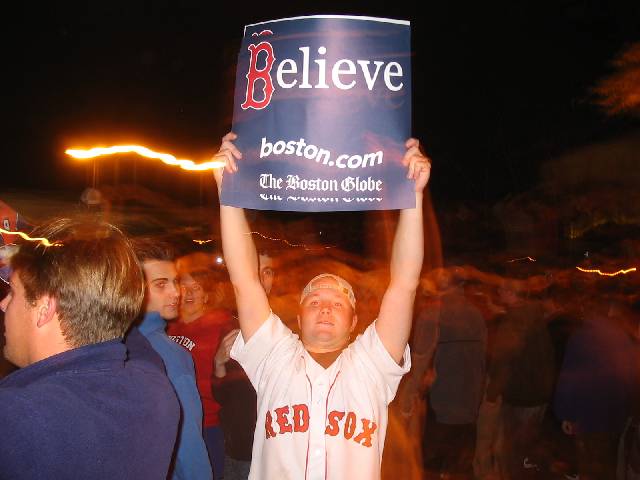
If you have ever had the pleasure to be at Fenway park for a Red Sox vs. Yankees game, you will know that there will up upwards of 10 fistfights that break out by the end of the game. Of course 10 out of 10 fistfights are between fans of the opposing teams. (and 10 out of 10 of the arrested fans are Yankees fans...but I digress)

Why is it that Red Sox fans don't fight each other? Is it because we are all the same, that we live in peaceful harmony, always agreeing with each other and never arguing? Nope. During a typical game, while sitting rather peacefully in my seat, I will have beer spilt on my by some drunken jerk, have my view blocked by some idiot standing up in front of me to take 12 pictures, and have chewed peanuts sprayed on me by the lady in the seat behind me who's yelling, "A-ROD'S AN A-HOLE!" But I love them all, because we are all Sox fans. We have laughed, cried, screamed, cried, and rejoiced together. We have sat, stood, and kneeled and prayed together. And that shared suffering, that shared jubilation, unites our souls forever, and any adversary from New York or otherwise be damned.

You may have noticed the resemblance between the scene I have described and a typical Catholic mass. In fact, the similarities cut deep, very deep…


Creationists vs. Evolutionists


The only place I have been to that rivals the childish fighting between Red Sox and Yankees fans has been at a meeting between creationists and evolutionary biologists. They screamed at each other, pumped their fists in the air, stamped their feet, and I heard almost every insult short of "Oh yeah, well you're a poop-head!" hurled from each side. The reason for this fighting is much the same as the brawls at Fenway. Each side, through their shared dreams, hopes, and experiences of suffering and jubilation, has constructed a shared worldview that cannot be questioned.


One common criticism that has always been raised against science is that it offers a cold and belittling picture of our insignificant place in a mechanistic universe, while religion puts humans at the spiritual (if not physical) center of a warm, vibrant universe that was given to us as a gift. I'm here to say that it doesn't have to be this way!

Who Created Whom in Whose Image?

Each person's view of God tells you more about that person than it ever could tell you about God. Ever notice how only funny people claim that God has an infinite sense of humor? Or that the embattled and persecuted Jews from the Hebrew Scriptures viewed their God as testy, vengeful, demanding, and at times almost irrational? Or how the ancient Greeks, as they uncovered the wondrous insights of geometry, mapped these principles into their view of the Heavens and the Earth's place at the center of the Celestial Spheres?


I think the reason that science is perceived to give a cold, mechanistic view of the universe is for much the same reason--this is the view that was held by the cold, impersonal scientists who came up with the big theories. Newton, for example was reported by those who knew him to be a misanthropic prick. It is only natural for such a pompous genius to assume that universe must conform to his own values of logic and mechanism—hence the clockwork universe that needs no further care once set in motion.

I argue that this bleak picture of the universe is really not indicative of science, but rather of the scientists who conceived it. It doesn't have to be this way. Whether you believe in God or not, I believe science can paint a picture of the universe every bit as wondrous and welcoming as that held by believers. All it takes is a change in perspective.

Tiny, but Not Insignificant
The more we study the universe, the more we find out how small we are compared to it. Space is mostly, well, space. If the Sun were the size of a grapefruit, then Earth would be a pencil point 30 feet away. Pluto would be in the next town, and you’d need a microscope to see it. The nearest star would be another grapefruit, on the other side of the country, with nothing in between. Once you realize how much nothingness there is in the universe, it makes it really special that we are part of something.

We, all of us, are on the same little blue speck of dust, hurling around a little bright dot on the far reaches of a dinner plate hurling through an infinite space at unimaginable speeds. What if there is nothing else; no afterlife, no spiritual realm—what then? Then that would mean we were all in this together, this 'life' thing, with all the joy, suffering, love, and pain that comes along with the human experience. We are all rooting for the same team. If nothing else, can't THAT make us get along??


Saturday, March 8, 2008

Thoughts in Honor of Einstein's Birthday

"There are only two ways to live your life. One is as though nothing is a miracle. The other is as though everything is a miracle."


I have heard this quote often attributed to Einstein, but I've never heard it in its original context. I'm not sure which of the two options he meant to be 'better', if either of them. However, it does seem to me that at least implicitly, he lived as though nothing is a miracle. That is, he at least did science as if everything is explicable in terms of the elegant yet strict laws of nature.


His theory of relativity took away the miracle of gravity. To Newton, it was a miracle that masses exerted forces on each other; and moreover that the very masses that create the force of gravity also resist it proportionally. Why should the universe conspire to make sure everything falls at the same rate?? For Einstein, this was no miracle. Nor was it a miracle that even light was bent by gravity. It was inevitable. The curvature of spacetime tells matter how to move, and matter tells spacetime how to curve. Both oblige eachother, with no choice in the matter, so to speak. That is why, on the eve of the solar eclipse that would determine whether he was the greatest scientist of his day or whether he was just plain wrong, he went to bed early. If the observation went against his prediction, he quipped that he "would have felt sorry for the Lord--the theory is correct!" And, of course, it is.


Perhaps the only miracle in Einstein's universe was the fact that the laws he discovered were so simple. G=8*pi*T--that's it! This elegance fascinated him: "The only incomprehensible thing about the world is that it is comprehensible." But he was not content to concede this as a miracle, either. He spent the last decades of his career trying to unify all the known forces of nature into one ultimate law. His ultimate goal in this program, what really interested him, was "whether God had any choice in creating the universe." If his program had succeeded, then perhaps the answer would be no, he had no choice. The equations determine everything.


That seems to me to be precisely why Einstein hated quantum mechanics so much. The laws of nature don't determine where the particles are or where they go; it's pure chance. Thus, he was forced to treat each and every moment as if it were a miracle. Or rather, 10^83 miracles. "I don't believe that God plays dice with the universe." That would mean that God had--and continues to have--no choice in creating it, no choice in how it all unfolds. This seems to weigh against the point I was making with Einstein's quest for unification, but in this case even the equations didn't determine everything, and that's what really bugged him. But on the other hand, if even God doesn't have a choice in the matter, would that be the ultimate miracle??

Friday, January 11, 2008

A victory for the common folk

Warning: this post is a weblog-rant, aka a "blant." Read at your own risk.

Fact: You are an organism made of tens of trillions of cells--microscopic organisms that have no idea who you are and couldn't care less about your needs.


This is the concept of an emergent property--a quality possessed by the whole but not by its parts. The property of 'you-ness' emerges out of the interactions of trillions of you-less cells.

Fact: Sprint PCS an entity is made of thousands of employees--macroscopic organisms that have no idea who you are and couldn't care less about your needs. But out of the scripted interactions between these employees emerges a company that knows and cares who you are to the extent that they want all of your money with as little in return as possible.

The way Sprint PCS treats customers is pure evil. However, to blame any individual employee for this evil would be like blaming an isolated skin cell in your arm for punching that hobo down by the railroad tracks (yes, I know about that, you sicko). Sprint made the genius move of hiring so many employees that when blame is distributed amongst them, it is such a thin layer of guilt that they can simply brush it off their shoulders as they disconnect you. Any amount of blame, divided by infinite, equals zero. So, the only entity left that you can be mad at is Sprint PCS, which takes the form of a 1,000 foot hydra made of smoke. Very hard to fight.


But, I have fought. Through a brave display of calm-headed civil disobedience (i.e. a very sophisticated form of laziness and avoidance), I have fended off the evil empire and restored peace throughout the land. Let me briefly summarize the epic battle:

It all began on a night just like this. I had finally gotten the phone I ordered from sprint.com, which was 100% satisfaction garaunteed for 30 days...what's the risk? I followed the instructions, using the phone to call the toll free activation number. The first person couldn't activate it, so I was transferred to an activations manager. They could not activate it, so I was transferred to a managerial manager. They also were unable to activate me, so I was transferred to the boiler room of one of Sprint's Indiana offices...which ironically was the most helpful department to this point. They couldn't activate my phone, but they knew who could, and they transferred me to the Great Wizard.


"WHO DARES DISTURB MY SLUMBER?!" bellowed the Great Wizard.

"It is I, Sir Luke" I answered, trying to maintain a facade of self-confidence.

"WHAT IS YOUR QUEST?!" the Great Wizard's voice was like a thunderstorm.

"Oh Great Wizard, I humbly seek to activate my new phone."

"WHAT IS YOUR 13 DIGIT ACTIVATION CODE?!!"

"I don't know, your majesty. Forgive my ignorance, but where can such a number be found?"

"WELL, INSIDE THE BATTERY CASE OF YOUR PHONE, OF COURSE!"

"The very phone that I was instructed to use to call you, oh Great One?"

"YES, FOOL, THE VERY PHONE WITH WHICH YOU TALK TO ME NOW"

"Oh, dear. So you're telling me that I have to hang up, after nearly an hour and forty-five minutes of being transferred around, in order to get the number to activate my phone, so that I can call back and wait another hour to be transferred back to you, oh great one, in order to activate my phone?"

"YES."

"Why don't we just call this whole thing off. I'll send my phone back to you & get my money back."

"FOOL!! YOU MUST WAIT FOR THE ILLUSTRIOUSLY DIVINE RETURN KIT AND CALL US WHEN YOU HAVE THE UPS 13 DIGIT TRACKING NUMBER BEFORE YOU CAN SEND THE PHONE BACK! YOU ARE HENCEFORTH BANISHED!!"

And so I waited for the illustriously divine return kit, which surprisingly never came. After trying to sort this whole mess out with at least 27 different employees, after 8 hours of phone calls (70% of which were disconnected) I was told to just send the phone back myself, without the illustriously divine return kit, and keep my fingers crossed.

The next correspondence I got concerning the matter was from a debt collecting agency. They sent me weekly phonecalls and bi-weekly emails threatening to pummel me, stab me, and even make me watch reruns of Alf until I give them $167.23 immediately.

I could write a book about all the fruitless phonecalls I made to resolve this matter, but the short version is that there were a lot of them, and they were epic in their fruitlessness.

But a New Year's miracle occured: a voicemail from Sprint on New Year's Day said that my debt would be essentially cut in half, with no particular reason cited.

Finally, this week, I was sent my final bill. (This was my 7th final bill to date...but I digress). It's hilariously mysterious contents, whose hilarity is surpassed only by their mysteriousness, are included below. Note the strange list of random deductions less than a dollar. However, the real interesting part is the "good will" credit. At last, we return to today's lesson...that amongst the interactions of countless employees completely devoid of good will, good will can emerge. And that's all I have to say about that.

Saturday, September 29, 2007

Lakatos & Feyerabend


Milk & fire,
Beethoven & Mozart
love & lust
trust, faith & regret

Not polar opposites, but just
different enough to really
dig each other.
Like sodium & chlorine
no one can really explain
why they come together-

they've no business doing so, but
still they do.
Electrically they're neutral
But there's something about each one
that the other finds so
dangerous, so preposterous, so ridiculous
that they each move in to take a closer look.

Keep your friends close,
and your enemies
closer.


Wednesday, September 5, 2007

Does Everything Happen for a Reason, or a Purpose?

What is the question?
This is an important question…perhaps the important question…and boy, is it a doosy. But that’s what makes it so much fun to think about…

First I would like to clarify some terminology here. I think that when people ask the question, they really mean ‘Does everything happen for a purpose?’ which is a religious or spiritual question. Whether or not everything happens for a reason, on the other hand, seems to be more of a question for science or philosophy. Both are interesting, important questions. Perhaps they are connected somehow, but for now I would like to consider them separately.

Does Everything Happen for a Reason?
As an aspiring scientist with a realist and perhaps coherentist epistemology, I would like to think that the answer to that is yes. In fact, I would like to think of science as the search for explanation—the search for reasons. Why did the apple fall from the tree? For Newton, the reason was the force of gravity (working in tandem perhaps with the wind to knock it loose). For Einstein, the reason was the curvature of spacetime. In many cases, the art of physics seems to be the art of creatively finding the reasons that things happen in the physical world. Given the laws of physics and the initial conditions, the apple was bound to fall. A physicist gets paid to search either for the laws or for the initial conditions (or a little of both). When they have both, they have found an explanation to the natural phenomenon.

Are you sure??
This view that everything happens for a reason, which I hold dearly, has some serious challenges. I cannot respond to all of them, which scares me. There are two main branches of physics that challenge the proposition in different ways—one attacks our knowledge of the initial conditions, the other of the very laws themselves.

Insanity: doing the same thing over and over again and expecting different results.
Albert Einstein (1879 - 1955), (attributed)

Chaos theory threatens our ability to find the reasons behind things. ‘Chaos’ is defined in physics-ese as an extremely sensitive dependence on the initial conditions…therefore, for some things (like the weather & the stock market) we can never do the same thing over and over to test whether we have found the reasons behind it. However, there are patterns among the chaos that allow us to test them slightly more holistically; hence the ‘theory’ part of chaos theory.

Quantum mechanics presents us with a much more serious threat to believing things happen for a reason. In quantum mechanics, we can do the exact same things over and over, and the results are always different! All we can do sometimes is give the probabilities of an electron taking a certain path, and it is the probabilities that follow strict laws & equations. Take nuclear decay (please!). We can never predict exactly when a uranium atom will decay, but we can tell that it will have a really good chance of decaying after a certain time. Put another way, there is no reason for it to decay at any particular time. Einstein didn’t like quantum mechanics for this reason (among others), and famously quipped, “God does not play dice with the universe.” Well, Alby, I hate to say it but it seems like you were wrong about this one! Perhaps the most troubling aspect is when you realize that our everyday world is composed of these inherently random particles that do not obey simple cause and effect.

I have a hope, however, that reasons can emerge out of these little things that don’t abide by reason. For example, you are built out of about 10 trillion cells; each cell is its own living organism, but none of them are ‘you.’ None of them even know who ‘you’ are! It is through their myriad ‘you-less’ interactions that you emerge (fortunately for you). Likewise, perhaps everything in our macroscopic, everyday world can still happen for a reason, even though our everyday world is built out of a strange, reasonless quantum world. That’s my two cents, anyway.

Does everything happen for a purpose?
Like the previous question, I’m very conflicted on this. On the one hand, I want to answer with an emphatic “yes!” I feel it in my bones. It certainly seems like life is taking me on some sort of path…there seems to be some sort of grand plan. One of my first major results of grad school was proving that god exists…I proved this by finding a Dunkin’ Donuts on my way to school;)

On the other hand, and more seriously, I want to scream “NO!!” when I think about things like the Holocaust and senseless murder. What could possibly be the purpose behind such things?? I tend to think that no moral god could ever condone such atrocities, let alone build them right into His/Her plan.

Clearly, I have no qualifications to answer this question. It may be the biggest one of all. But you may like to hear the solution that sticks to my ribs these days. I think it may be sort of the opposite of emergence (‘de-mergence?’). On a large scale, there is no such thing as a grand plan. But on an individual level, it makes a lot of sense. It may be like being in love: by believing it, you make it true. In my mind, this does not belittle the notion of ‘purpose’ in the least. It makes it more real than anything.