
Monday, November 17, 2008

Friday, September 19, 2008
Are You Liberative or Conserveral?
Once upon a time, there were couple mild-mannered, well-meaning political ideologies: liberalism and conservatism. Liberals would have you believe that the government should be utilized to solve problems. Conservatives would have you believe the opposite; keep the government out of our lives and we can solve our own problems. For example, the welfare system was started by the liberal FDR to allocate government money to give relief to the poor, among other things. Conservative critics hold the current welfare system up as an example of "big government" sticking its tail where it don't belong.
The distinction is not, and perhaps never was, so clear cut as either side thinks. Conservatives cry for the government to get out of their lives (e.g. taxes, gun control, welfare), while paradoxically condoning government control of much more personal things like high-stakes standardized tests, wars, drugs, abortions, euthanasia, and same-sex marriage. Liberals are arguably just as self-contradictory, pushing for racial, sexual, and socioeconomic justice from up on a pedestal. For example, 72% of all university faculty are liberal, while they work in environments that continue to have severe inequalities in tenure and pay with regard to race and gender.
Recent studies in psychology have started to reveal a new picture of the distinction between conservatives and liberals. The greatest predictor for whether you are a liberal or conservative is the extent to which you feel open to new life experiences. The second greatest predictor is the number of body piercings.


Pop quiz: which of these dudes is a liberal?
Go to http://www.yourmorals.org/ and take one of the quizzes, to see where you stand (don't worry, the site is a legit research site). Far from having political origins, the distinction between liberal and conservative has more to do with one's sense of morality. Conservatives tend to value loyalty to a group, whereas liberals tend to value "fairness" amongst a group. Here is my graph, where green represents my score (blue is liberal, red is conservative):

As you can see, I'm conservrativally liberacious. And part German.
Tuesday, September 16, 2008
Musicians are underrepresented amongst our national holidays
 Holidays are our nation's way of ceremonially celebrating it's most influential people and its proudest accomplishments. They are dedicated to the nation's founders, leaders, influential politicians, and pivotal events.
 I think it's safe to say that music is one of the finest gifts to the world that the United States has offered. To quote House Resolution 57, passed by the U.S. Congress in 1987:
Whereas, jazz has achieved preeminence throughout the world as an indigenous American music and art form, bringing to this country and the world a uniquely American musical synthesis and culture through the African-American experience and...makes evident to the world an outstanding artistic model of individual expression and democratic cooperation within the creative process, thus fulfilling the highest ideals and aspirations of our republic...it is the sense of the Congress that jazz is hereby designated as a rare and valuable national American treasure to which we should devote our attention, support and resources to make certain it is preserved, understood and promulgated.
I suggest that one great way to devote our attention, support, and resources to our native music idioms such as jazz would be to dedicate national holidays to our greatest musicians.
Perhaps for starters, we could make next Tuesday, September 23rd, "John Coltrane Day". John Coltrane was born September 23rd, 1926 in Hamlet, NC. On stage and on record, he traveled deep inside to bring back out for his audience virtuosic and hearfelt "sheets of sound". His music captured the complexities of the experiences and emotions conjured by life in tumultuous times. His music evolved from cries of despair to soothing cries for peace and ascension. His music has not only stood the test of time, it is timeless. He has influenced generations of musicians to search for diligent virtuosity as well as true expression.
Isn't that enough for one day of recognition?
Friday, September 5, 2008


Tuesday, July 29, 2008
Guess who's back in style??
 Back in style: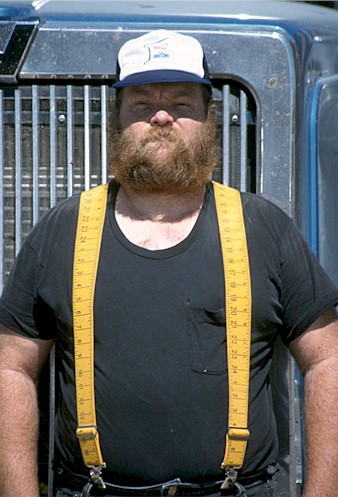
Truckers! Truckers stole our hearts with their dedication to supply all of our goods while looking stylish and talking cool the whole time.
Ten-four there, Goldie Wang. This is Rubber Duckie. What's your ten-twenty? Over.
Back in Style:
 Ninjas! Ninjas are sweet and totally fast. They will kick you in the face and not think twice about it. That's why ninjas are cool again.
3 Facts about ninjas:
1. Ninjas are mammals.
2. Ninjas fight ALL the time.
3. The purpose of the ninja is to flip out and kill people.
2. Ninjas fight ALL the time.
3. The purpose of the ninja is to flip out and kill people.
Back in Style:

Pirates! Avast! If'n ye don't think pirates be grand, fine booty, then by the powers you land-lubbers will be fixin' for a taste of the cat o' nine tails. Argghh.
Q: What kind of socks to pirates wear?
A: AAAARRRRGGGGuile
Soon to be back in style:
 Pilgrims! Pilgrams are zany and happy-go-lucky, as you can tell by their hats. They love to eat corn, make cornucopias and fire muskets. Fact: A pilgrim can make 3x his/her own bodyweight worth of pumpkin pie in one sitting. That's why pilgrims are going to be the next big thing.
 Pilgrims! Pilgrams are zany and happy-go-lucky, as you can tell by their hats. They love to eat corn, make cornucopias and fire muskets. Fact: A pilgrim can make 3x his/her own bodyweight worth of pumpkin pie in one sitting. That's why pilgrims are going to be the next big thing.
In honor how cool pilgrims are, I hereby declare this Friday, August 1st 2008 to be the first annual International Dress-Like-a-Pilgrim Day!!! Who's with me??
Friday, July 25, 2008
Uncommon Courtesy
This is my friend's awesome band called Hugo...I'm actually playing bass on this track. Check it out and let me know what you think!
Uncommon Courtesy
Hugo's website: http://www.hugorock.com
Uncommon Courtesy
Hugo's website: http://www.hugorock.com
Wednesday, May 28, 2008
When it rains it pours. Here’s why.
I have been doing a final project in math class on how long it takes a cement square to completely saturate with rain at the start of a rainstorm. Inadvertently, I missed my last class to do gather some observational evidence in Mallorca, Spain.
 It was, as a trip, comparable to National Lampoon's European Vacation, and I was Clark Griswold. I will spare you the details expect for a highlight real: it poured rain the whole time, my uninsured rental got keyed, and I ran over Eric Idle while he rode on his bicycle.
The pinnacle (or whatever is opposite of pinnacle, that is) of the madness was when the rental car broke down in the most precarious spot of road ever invented—a hairpin turn on the side of a mountain with a cliff on either side. Actually, with the magic of Google maps, I can show you. It was right here:
 Just for fun, here's a contour map, and if you've studied your contour maps (you have, right?) you will see it's WICKED STEEP:

The car battery just died as I was making the turn. Since we were going up a hill, I had to back it down out of the dangerous curve. Since the power steering was dead, I had to back it into the wrong lane. Since it was in Mallorca, we had no working cell phone and thus we had to stop cars by hand to ask for theirs. Since they were all tourists, they didn't have any either.

Just when we flagged down the most amazingly nice French couple who offered their help, all of a sudden a lightning storm surrounded us that was so fierce it seemed as if God was trying to personally smite us after a few glasses of Mead.
One thing I noticed as I stopped traffic to (a) prevent a disastrous cataclysm and (b) find a cell phone, I noticed something on that road. It never seemed to be one car that went by, enabling a safe stopping for help. It was always a cluster of cars and buses meeting perilously at the bend in the road, even if it was 10 minutes since the last car came by, making it a completely dangerous situation every time. (wasn't Avis so nice to tell us to just "deal with it")
I think Tom Robbins puts it best in his classic Another Roadside Attraction. The narrator notices how Amanda and John Paul Ziller walk through the Seattle rain:

 It was, as a trip, comparable to National Lampoon's European Vacation, and I was Clark Griswold. I will spare you the details expect for a highlight real: it poured rain the whole time, my uninsured rental got keyed, and I ran over Eric Idle while he rode on his bicycle.
The pinnacle (or whatever is opposite of pinnacle, that is) of the madness was when the rental car broke down in the most precarious spot of road ever invented—a hairpin turn on the side of a mountain with a cliff on either side. Actually, with the magic of Google maps, I can show you. It was right here:
Just for fun, here's a contour map, and if you've studied your contour maps (you have, right?) you will see it's WICKED STEEP:The car battery just died as I was making the turn. Since we were going up a hill, I had to back it down out of the dangerous curve. Since the power steering was dead, I had to back it into the wrong lane. Since it was in Mallorca, we had no working cell phone and thus we had to stop cars by hand to ask for theirs. Since they were all tourists, they didn't have any either.
And since we were in such a dangerous spot, I got to wear a sweet yellow vest (that really tied my whole outfit together) and we had to put up a danger triangle. Here's a pic of me directing traffic in my snazzy vest:
Just when we flagged down the most amazingly nice French couple who offered their help, all of a sudden a lightning storm surrounded us that was so fierce it seemed as if God was trying to personally smite us after a few glasses of Mead.
One thing I noticed as I stopped traffic to (a) prevent a disastrous cataclysm and (b) find a cell phone, I noticed something on that road. It never seemed to be one car that went by, enabling a safe stopping for help. It was always a cluster of cars and buses meeting perilously at the bend in the road, even if it was 10 minutes since the last car came by, making it a completely dangerous situation every time. (wasn't Avis so nice to tell us to just "deal with it")
Why do cars always cluster in the worst possible way? Why do bad things come in three's (or in the case of this trip, bazillions)? I can see 2 answers to these questions:
- There could be a selection effect. There may be many cars that go by alone—many bad things that happen in isolation all the time—but since they did not lead to near disaster I didn't notice them as much.
- There could be a mechanism at work. In the case of cars, there are always cars that are slower than the average. The faster cars will tend to get stuck behind them, making them all travel together as a clump. In the case of bad things, the first one will put us in a bad mood, which makes it all the more likely that we will see more events as "bad," or worse, even start to make bad things happen.
I think the real answer is a little of both. And the solution is acceptance. At best, you will see less bad things happen. At worst, you won't be able to prevent the bad things from happening anyway, so you might as well accept them so you can move on.
I think Tom Robbins puts it best in his classic Another Roadside Attraction. The narrator notices how Amanda and John Paul Ziller walk through the Seattle rain:
"They strolled calmly and smoothly, their bodies perfectly relaxed. They did not hunch away from the rain but rather glided through it. They directed their faces to it and did not flinch as it drummed their cheeks. They almost reveled in it. Somehow, I found this significant. The Zillers accepted the rain. They were not at odds with it, they did not deny it or combat it; they accepted it and went with it in harmony and ease. I tried it myself…I got no wetter than I would have otherwise, and if I did not actually enjoy the wetting, at least I was free of my tension. I could even smile."
And so we tried, on that precarious bend in the road, to smile. And the French couple that was helping us smiled. And more people stopped to help us. In fact, one of them road over our danger triangle and destroyed it. Instead of thinking, "oh great", we laughed. Eventually Avis came around and gave us a new rental. We made it to the top of the mountain, and the clouds broke, offering us one of the most amazing scenes I have ever taken in.
I think the answer, expressed in its most direct form, was taught to me as a poem by my father when I was young:
Smile a while
and while you smile
another smiles
and soon there's miles and miles of smiles
and life's worthwhile,
because you smile.
Subscribe to:
Posts (Atom)